Contingent Development
TREDIS provides an option for modeling Contingent Development, which is expected economic development that is contingent upon transportation investment. Industry impacts may be entered as sales (output) in millions of dollars or as employment as the total number of jobs added.
An example situation where Contingent Development would be useful is a warehouse that is being considered for development depending on whether access is improved. In the Project alternative, access is improved, and the warehouse is built, adding output and jobs to the local economy (whereas, in the Base alternative, the warehouse would not be built so no added output or jobs would be present).
This is useful because it allows further accounting within TREDIS (and thus within the Economic Impacts Analysis provided by TREDIS) for important economic events that are not directly reflected in improved travel efficiency (which would be reflected in inputs on the Travel page) or new construction or maintenance commitments (which would be reflected in inputs on the Costs page).
Entering Inputs
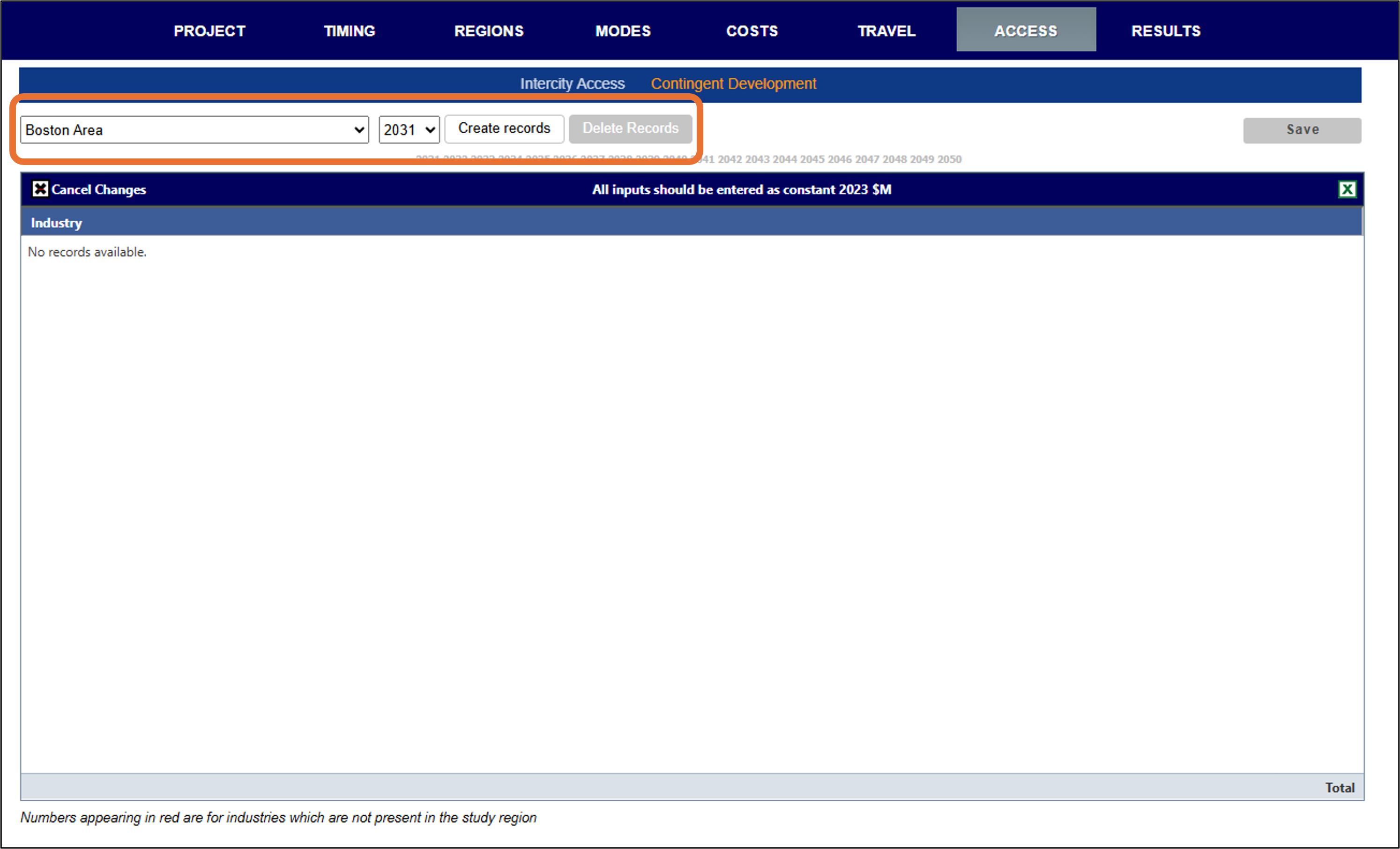
For a new project, on landing on the Contingent Development tab (under the Access page), you will see no records entered yet, as in the figure below. The box highlights the controls for choosing the Region and year where the contingent development would take place.
In this example, where a warehouse would be built contingent on the Project alternative being built, we enter 200 new jobs that the warehouse would support in the appropriate industry, then click the Save button to save this record.
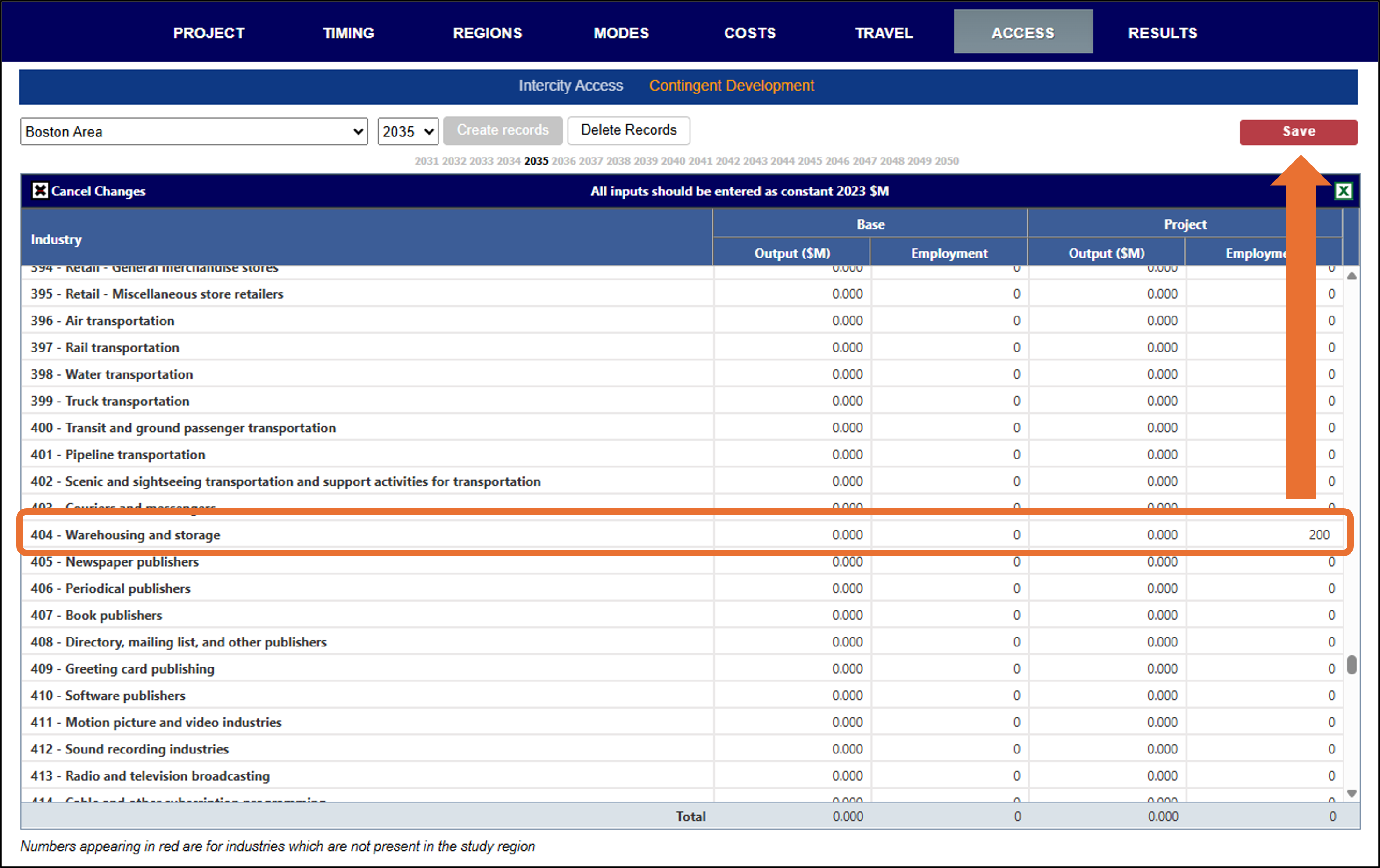
If this new economic impact would last for the remainder of the Operations Period (defined on the Timing page), nothing more needs to be done. If another facility or change in the economic picture would occur in another year or region, enter that as a separate record.
For example, if the warehouse opening in 2035 (entered in the above example) with 200 jobs would expand in 2037 to support 400 jobs, create a record for 2037 and enter the data to model that.
In addition to commercial, retail, industrial and government sectors, the Contingent Development module also supports changes in households' "output" - here understood to be household income. Any change that would increase households' ability to spend could be input as a difference between the Base and Project values in the first "Industry" listed, Household Spending. Enter data in the Output ($M) to model any changes between the alternatives in households' income.
Interpolation
In cases where Contingent Development is entered for some years but not others, TREDIS interpolates and expands Contingent Development values to other years using rules similar to those used to expand and interpolate Travel characteristics. Trends of increasing or decreasing values are respected between and beyond the years input. This is intended to simplify data entry for those wanting to enter Contingent Development across multiple years where trends are observed but modeling has not been explicitly done.
Imputation between explicit zero values and non-zero values is allowed, as well as beyond the final input year, which is similar to how Travel data is expanded. When no zero value is explicitly set, all years until the first explicit entry are treated as zeros. Notably, this last rule is different from the method to expand Travel data across years, but is more intuitive for the behavior of Contingent Development, where discontinuous values are much more likely to be modeled. For instance, if a new factory, warehouse, or other source of employment opens in a given year, it might be very natural to model a large increase in the employment in that year that is a discontinuous jump from the year before.