Congestion
In TREDIS, the fraction congested is used to estimate how much vehicles are subject to extra costs from travelling in congested conditions, such as operating costs (e.g., wear-and-tear on brakes) and reduced fuel efficiency (from start-and-stop conditions). The concept of buffer time is used to represent time that is added to trips to account for unreliability. Unreliable travel times cause travelers to make early departures to buffer against potential delay. In TREDIS, buffer time represents the extra scheduling time in hours that ensures on-time arrivals for 95% of the trips.
Changes in congestion between your Base and Project alternatives will affect vehicle fuel efficiency. Changes in reliability (via buffer hours) affects time savings (both for private and crew travel), and freight logistics.
The metrics on the Congestion tab work in conjunction with the Congestion-Reliability Input Method control at the top of the Travel page.
Note that these variables and related factors are only used and calculated for private vehicles that use the Road facility.
Choosing the Congestion-Reliability Input Method
The Congestion-Reliability Input Method control has radio buttons and a dropdown, as shown in the figure below.
Use the radio buttons to select Both, Fraction Congested, or a reliability metric. Selecting the radio button next to Fraction Congested means you will enter only fraction congested. Selecting the radio button next to the reliability metric means you will only enter the reliability metric selected via the dropdown. Selecting Both means you will directly provide both.
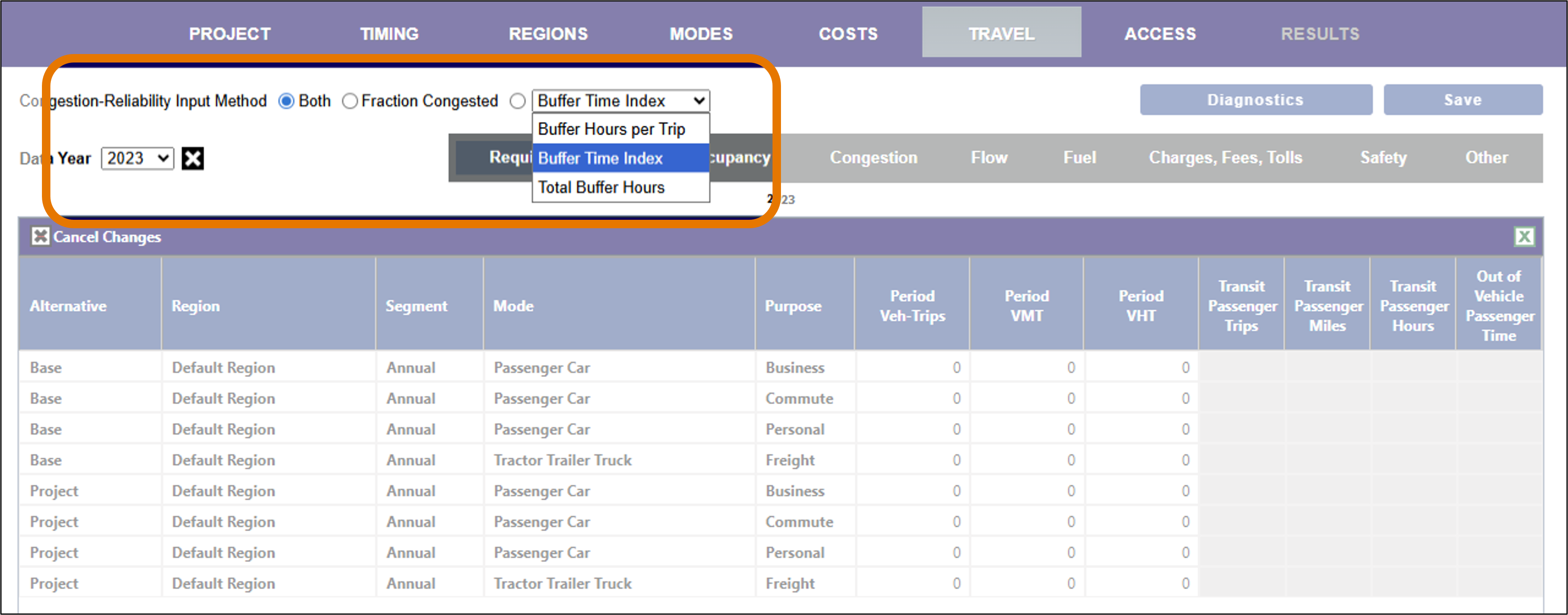
In practical terms, this means that if you choose Fraction Congested here as the Congestion-Reliability Input Method, you will only be able to enter data in the Fraction Congested column in the matrix below, and the buffer hours that travelers add to their trips will be estimated based on the congestion. Likewise, if you select the third radio button and select Total Buffer Hours, TREDIS will only allow data entry in that column, and will later impute the fraction congested when performing the analysis. This option can be seen in the figure below.
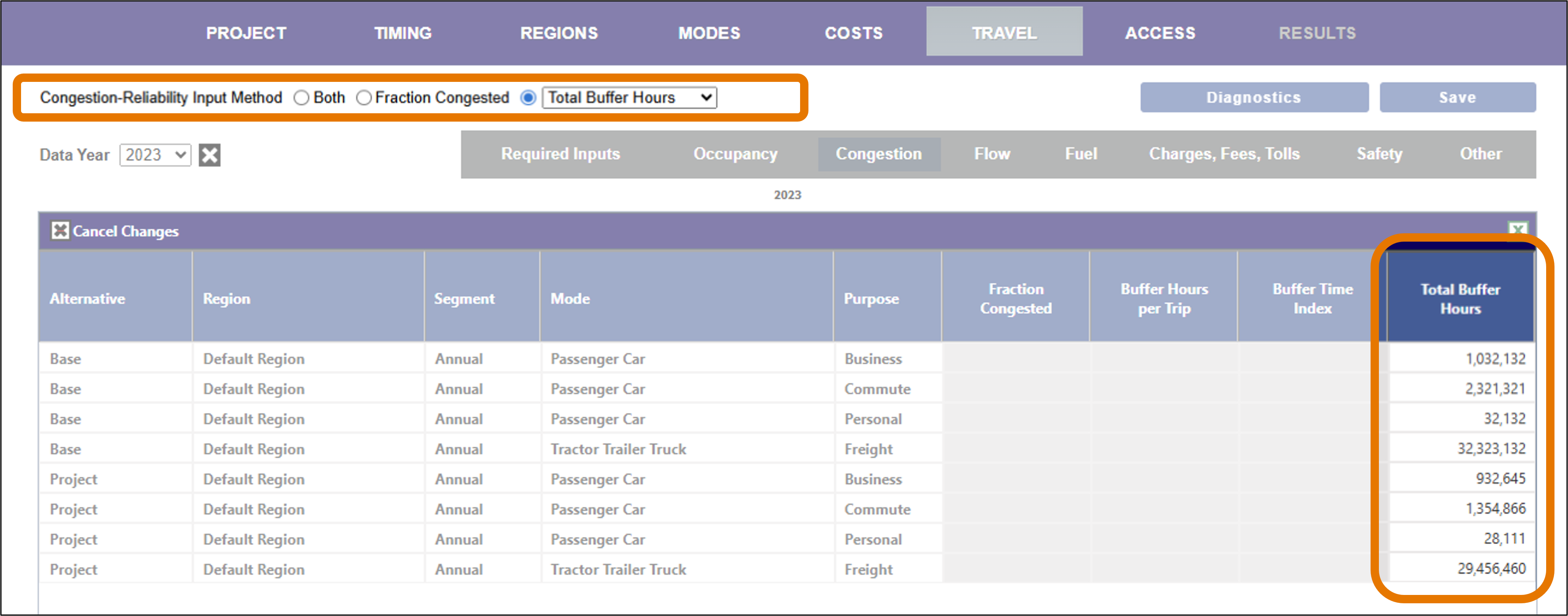
Finally, selecting Both will mean TREDIS expects you to enter both the Fraction Congested and whichever reliability metric is selected. Anything not entered will be 0 by default.
After changing the Congestion-Reliability Input Method, the variables you can no longer enter will be greyed out in the entry matrix, the Save button will toggle to red to indicate there are unsaved changes. When you click Save, the stored values for the variable being imputed will be calculated based on your preferred variable, overwriting any previous values input when your preferences were set to Both.
When switching between reliability metrics, TREDIS automatically recalculates the appropriate values to be the equivalent of any data already entered.
Data Fields
-
Fraction Congested. The fraction of all travel subject to congestion. For highway modes, it should be calculated as the fraction of VMT subject to a volume capacity greater than 0.9. The value represents a fraction, not a percent, so values must lie between 0 (no congestion) and 1 (pervasive congestion). Entering 0.3500 is valid, whereas entering 35 or 35% is not.
-
Buffer Hours per Trip. The number of hours of extra scheduling time needed to ensure on-time arrivals for 95% of the trips. For example, if a sample trip takes 30 minutes on average, but 1 out of every 20 days it takes 45 minutes, then the buffer time is 0.25 hours (or 15 minutes). This supports fractions of hours.
-
Buffer Time Index. The Total Buffer Hours as a fraction of total VHT. As an equation, Buffer Time Index = Total Buffer Hours / Vehicle Hours Traveled.
-
Total Buffer Hours. The total number of vehicle hours added as buffer. As an equation, Total Buffer Hours = Buffer Hours per Trip * Vehicle Trips.