Required Inputs
The Required Inputs tab is used to identify the number of vehicle (and in the case of transit modes, passenger) trips, distance traveled, and hours traveled.
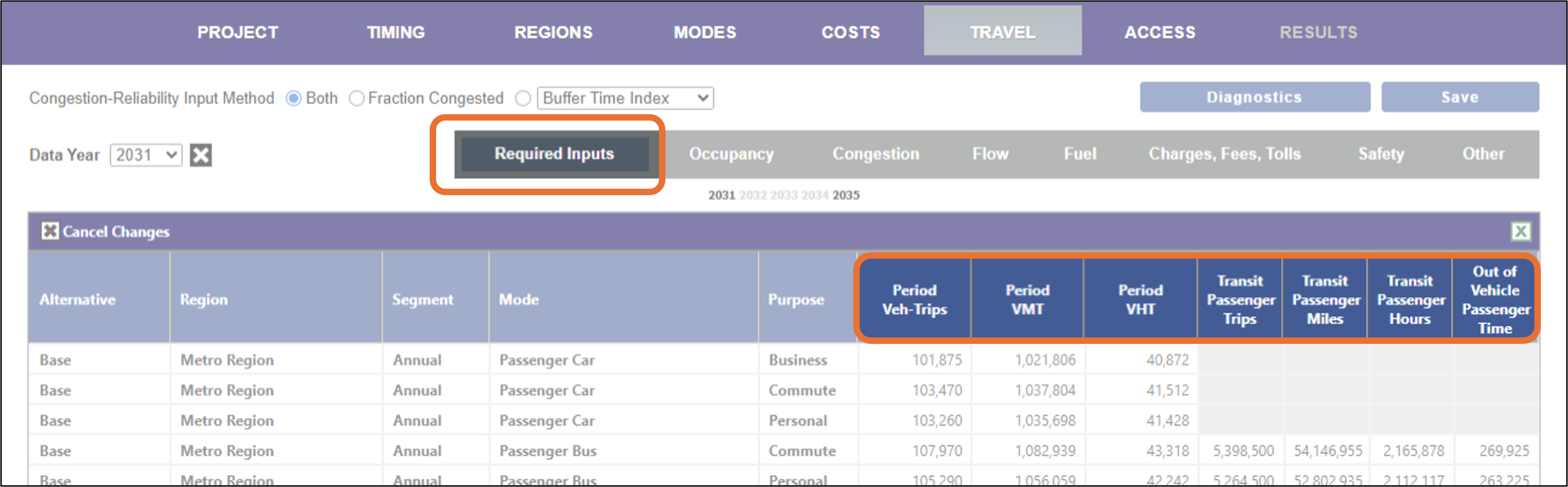
Data Fields
-
Period Veh-Trips. The annual number of vehicle trips.
-
Period VMT. The annual vehicle distance traveled, in miles.
-
Period VHT. The annual vehicle travel, in hours, not including buffer time.
-
Transit Passenger Trips. Total annual passenger trips that is, the sum of all passenger trips.
-
Transit Passenger Miles. Total annual passenger distance traveled, in miles.
-
Transit Passenger Hours. Total annual passenger hours traveled.
-
Out of Vehicle Passenger Time. Total annual passenger hours spent to wait or connect.
Considerations
Depending on the travel modeling inputs you are translating to TREDIS inputs, you may need to convert from a daily figure to the annual figure required by TREDIS. For example, you may need convert "average weekday" values to annual values, possibly by multiplying them by 260 (52 weeks x 5 days/week). Consult the travel demand model specifications for details on what outputs represent in order to convert accurately. If multiple Segments are included and represent periods on a single day, make sure to annualize them all.
Transit modes and aviation modes allow you to enter passenger trips, miles, hours, and out-of-vehicle time directly. For all others, TREDIS will calculate these using vehicle metrics by multiplying by the occupancy rates. (For Freight purposes, this means vehicle metrics are multiplied by average freight tons in US tons). All occupancy rates are entered on the Occupancy tab.
Conversely, for transit and aviation modes, the occupancy rate is not entered but is can be found directly by dividing the passenger metric by the vehicle metric. Note that this may not be the same for trips, miles, and hours depending on the passenger usage profile.
Effects of Changes in Required Inputs
While projects may be complicated and many metrics may change between Base and Project alternatives, it can be useful to remember some basic relationships that will drive changes in costs, since cost changes ultimately impact all categories of results.
- Changes in vehicle or passenger trips will drive changes in per-trip charges or fees. This means that for many cases, changes in trips will not by themselves greatly change cost. However, a change in trips can indicate that you will need to indicate to TREDIS what share are induced trips. See documentation on Trip Balancing for more.
- Changes in VMT between Base and Project alternatives will drive changes in crash incidence, vehicle operating costs, fuel costs, and environmental costs.
- Changes in passenger hours traveled (either directly or via changes in VHT) will drive changes in passenger time cost and crew time cost.
- Changes in VHT for freight purposes will drive changes in freight logistics delay costs.