2024-06 Societal Costs Travel
Summary
Per-mile rates for Societal Benefits and Societal Costs not captured by other default values are now available as input variables on the Travel page, which means they can be different between the Base and Project alternatives, between Regions, between travel Segments, and between Years. These rates default to zero cents per mile but allow consideration of many other effects of transportation investments and policies.
Induced benefit calculations have been refined to use existing costs for modes that are present in both the Base and Project alternative and an average cost from the Base alternative for new modes added in the Project alternative.
Societal Benefits and Costs on Travel Page
The new fields Other Societal Benefits ($/VMT) and Other Societal Costs ($/VMT) are available on the Other tab of the Travel page.
Among other applications, differentiating societal costs between the two alternatives (Base and Project) on the Travel page means that new amenities for pedestrians and cyclists in the Project alternative can lower the costs of travel in the Base alternative. This is especially helpful when applying the USDOT BCA Guidance for new pedestrian and cyclist amenities. Other potential uses of these variables include noise costs, physical activity benefits, and other public health benefits or costs of travel not captured by air quality variables.
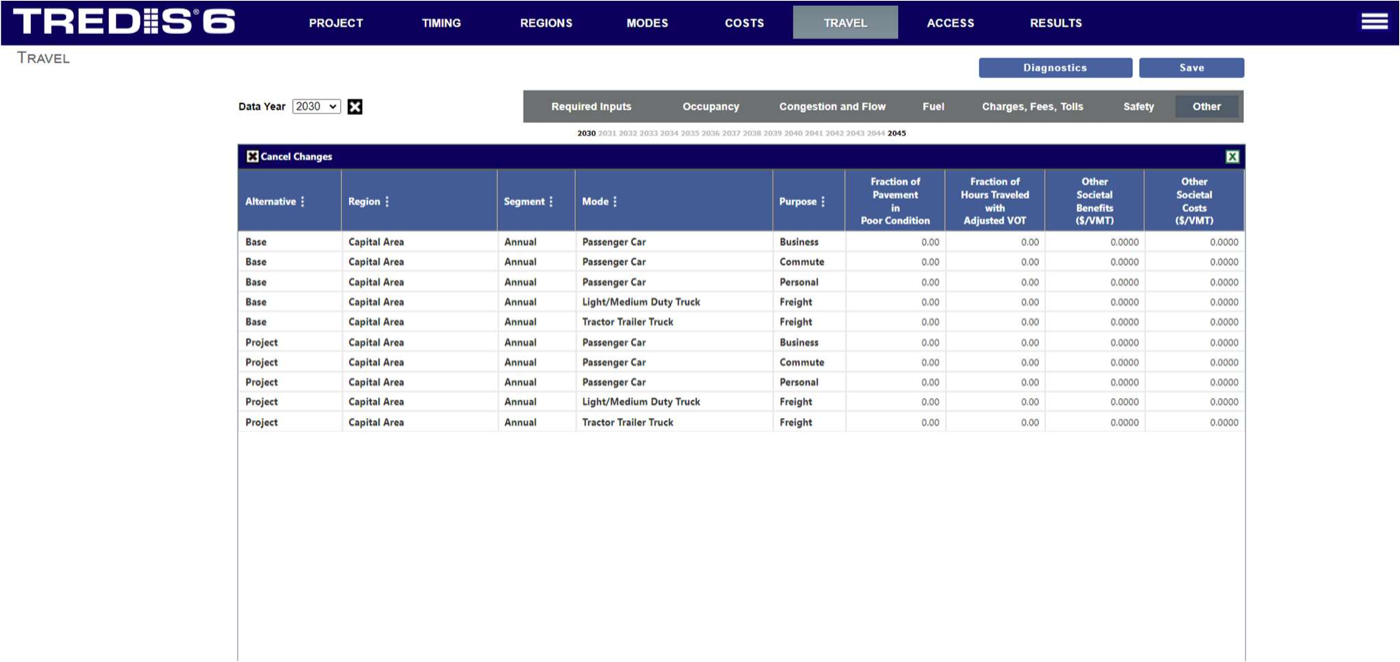
To accommodate the new fields for data entry in the Travel page, safety characteristics (fatality, injury, and crash rates) have been moved to a new, separate tab labeled Safety.
Other Societal Benefits and Other Societal Costs are already characteristics that can be edited for each mode and purpose via the Adjust Mode Factors button on the Modes page. Editing these characteristics on the Modes page before advancing to the Travel page will provide the default values for all years and all alternatives of Other Societal Benefits and Other Societal Costs on the Travel page. For all default modes, the default value of these variables is zero, but it can be edited for custom modes across all future projects, or for default modes in each project.
Refinement of Induced Benefit Cost Calculations
With this release, we further refine the TREDIS method for calculating induced benefit, building on the improvements discussed in Release Note 2024-05A.
Induced trips occur when improvements in costs experienced by travelers (often in terms of lower time costs, but not necessarily) bring new travelers into the system to enjoy the reduced costs. The induced benefit is a measure of these new travelers' consumer surplus.
The induced benefit is calculated by comparing travelers' costs in the Base alternative to their costs in the Project alternative. The recent update introduced a method that uses an average of costs experienced by travelers in the Base alternative to estimate the cost of travel for modes for which there is no Base alternative information. The average cost of all modes supporting that travel purpose provides a baseline to estimate the disbenefit people experienced by being unable to travel.
With this release, we refine the method so that the average cost is only used for modes being introduced. Existing modes, on the other hand, will simply use a cost comparison between the costs of the Project and the costs of the Base.
For example, if cars and subway are available in the Base project, but BRT is introduced in the Project alternative, commuters using a passenger car in the Project alternative will have their costs compared to the costs to commuters of using a passenger car in the Base alternative.
BRT commuters in the Project alternative, though, will have no pre-existing costs to have their costs of travel compared to, so their cost calculation will still use as a baseline the costs averaged between passenger car and subway in the Base alternative (weighted by number of passenger trips in the respective mode in the Base alternative).